// 08 · Free Tool
CryptoVault Portfolio Ledger
Keep a running record of every exchange and wallet you use — then log the coins, tokens, and precious metals held in each to see your full net worth at a glance.
⬇ Download Your CRYPTOVAULT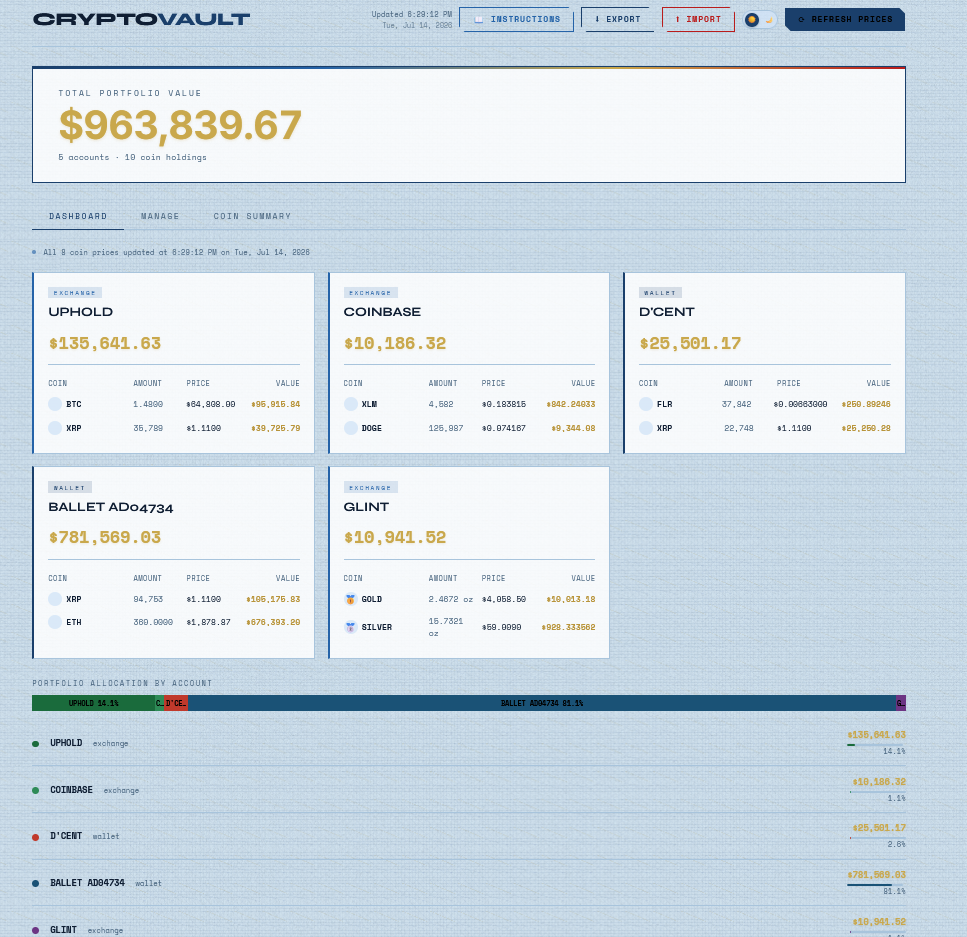
// Your guide to the digital asset ecosystem
Digital assets are rewriting the rules of money, contracts, and trust. Learn how blockchain technology works — and which tokens are leading the transformation.
// 01 · Foundations
A digital asset is any form of value that exists natively on a digital network — owned, controlled, and transferred without relying on a central institution.
Unlike a bank balance (which is really just a database entry at a financial institution), a digital asset on a blockchain is secured by cryptography and enforced by a decentralized network of computers. No single company, government, or administrator can unilaterally freeze, reverse, or inflate it.
Digital assets include cryptocurrencies (native coins like Bitcoin and Ether), tokens (assets issued on top of existing blockchains), stablecoins (price-stable tokens pegged to fiat currencies), and NFTs (unique, non-fungible tokens representing ownership of specific items).
What makes them powerful is their programmability. Unlike gold in a vault or dollars in a checking account, digital assets can be embedded with logic — automatically executing agreements, paying dividends, or reacting to real-world data — without any human intermediary.
// Types of Digital Assets
Cryptocurrencies
Native coins like Bitcoin and Ether that power their own blockchain networks.
Tokens
Assets issued on top of existing blockchains, representing utility, governance, or ownership rights.
Stablecoins
Price-stable tokens pegged to fiat currencies, enabling programmable, instant dollar settlements.
NFTs
Unique, non-fungible tokens representing ownership of specific items — art, collectibles, real-world assets, and more.
// 02 · Technology
A blockchain is a specific type of distributed ledger — a database replicated across thousands of independent computers, updated by consensus, and secured by cryptographic proof.
// What Is a Blockchain?
When BTC is sent from one wallet to another — or to an exchange — that transfer becomes a transaction. Thousands of transactions are continuously broadcast across the Bitcoin network every minute.
Approximately every 10 minutes, the Bitcoin protocol groups a batch of these pending transactions and packages them into a Block. Every transaction inside is permanently recorded and publicly auditable by anyone, yet cryptographically secured — no individual entry can be altered without invalidating the entire block.
A global network of computers called miners compete to "seal" each block. To do so, they must discover a specific 256-bit string of characters — called a hash — that satisfies the network's current difficulty target. This requires trillions of random attempts per second and is intentionally hard. The first miner to find the winning hash earns the right to add the block and receives a block reward in newly issued BTC.
Critically, each new block contains the hash of the block before it. This links every block back through history all the way to the very first — the Genesis Block — forming an unbroken, tamper-evident chain. Altering any past transaction would change its block's hash, breaking every block that follows and making fraud immediately detectable by the entire network. And so, as each new block gets added to the previous block, we create a chain of blocks — or a Blockchain.
Each block cryptographically references the one before it,
making history tamper-evident.
A user signs and broadcasts a transaction to the peer-to-peer network using their private key.
Unconfirmed transactions wait in the mempool, the network's holding area, prioritized by fee.
Miners or validators bundle transactions, apply consensus rules, and propose a new block.
The majority of nodes verify the block is valid and add it to their copy of the chain.
The transaction is permanently recorded. Altering it would require redoing all subsequent blocks.
Every block contains the hash of the previous block. If anyone tampers with a historical record, every block after it becomes invalid — making fraud instantly detectable across the entire network.
No single server or company controls the ledger. Thousands of independent nodes worldwide each hold a full copy. To corrupt the chain, an attacker would need to control a majority of the entire network simultaneously.
Once data is written and confirmed by consensus, it cannot be altered or deleted. This makes blockchains ideal for financial records, supply chain provenance, title registries, and any application where history must not be rewritten.
Networks agree on valid state through Proof of Work (competitive computation, used by Bitcoin) or Proof of Stake (economic collateral, used by Ethereum). Both make dishonest behavior prohibitively expensive.
Self-executing code stored on the blockchain that automatically enforces agreement terms when conditions are met — no lawyers, no escrow agents, no trust required between counterparties.
All transactions on public blockchains are permanently visible to anyone. While wallet addresses are pseudonymous, the full transaction graph is open and auditable — enabling unprecedented financial transparency.
// 03 · Use Cases
Not every token is speculation. The most compelling digital assets solve specific, expensive problems that existing financial and data infrastructure handles poorly — or not at all.
A store of value is an asset that retains purchasing power over time. Throughout history, gold served this role because it is scarce, durable, portable, and impossible to counterfeit or inflate arbitrarily. Bitcoin replicates these properties in a purely digital form — with important improvements.
Bitcoin's supply is capped at 21 million coins, enforced by consensus rules that no authority can override. BTC issuance through mining rewards is transparent and predictable, with rewards reduced by 50% approximately every four years through a process called the halving. The most recent halving occurred on April 20, 2024, reducing the block reward from 6.25 BTC to the current 3.125 BTC per block. The next halving is projected for April 2028, when the reward will drop again to 1.5625 BTC. This programmatic scarcity stands in stark contrast to fiat currencies, where central banks can expand money supplies at will.
Unlike physical gold, Bitcoin is natively digital: it can be transferred anywhere in the world in minutes, divided into 100 million units per coin (satoshis), and self-custodied without relying on any vault, bank, or intermediary. A 12-word seed phrase can hold billions of dollars in savings — accessible from anywhere on earth.
Litecoin offers faster block times and a larger supply for everyday payments. Monero adds cryptographic privacy, making transactions unlinkable by default — a distinct trade-off that appeals to those prioritizing financial confidentiality.
The original and largest digital store of value. Fixed 21M supply, 15 years of uninterrupted operation, the world's most secure and decentralized monetary network. Often called "digital gold."
Created in 2011, Litecoin processes transactions four times faster than Bitcoin with 84M max supply. It has served as a real-world testing ground for Bitcoin improvements like SegWit and Lightning.
A privacy-first store of value using ring signatures and stealth addresses to make all transactions unlinkable and untraceable. Used by those who require genuine financial confidentiality.
A smart contract is self-executing code deployed on a blockchain. It automatically enforces the terms of an agreement the moment specified conditions are met — with no lawyers, no banks, no escrow agents, and no room for one party to renege.
Imagine borrowing $10,000 against cryptocurrency collateral. With a smart contract, collateral is locked in code the moment you borrow, interest accrues automatically, and if collateral falls below the liquidation threshold, it is auctioned without any human decision. What used to require a bank, loan officer, credit check, and legal team now runs on a few hundred lines of auditable code — 24/7, globally, without discrimination.
Ethereum pioneered programmable blockchains and remains the dominant smart contract platform. Solana prioritizes throughput — capable of processing tens of thousands of transactions per second — and has attracted massive DeFi and NFT activity. Avalanche enables organizations to launch their own custom blockchains (subnets) with tailored rules, opening the door for regulated institutional DeFi.
Smart contracts power the entire DeFi ecosystem: decentralized exchanges, lending protocols, stablecoins, insurance, derivatives, and prediction markets — all running autonomously without corporate custodians.
The world's leading smart contract platform, securing over $50B in DeFi. Transitioned to Proof of Stake in 2022 (The Merge), dramatically reducing energy use. Gas fees power the entire ecosystem.
High-performance smart contract platform using Proof of History for parallel transaction ordering. Sub-cent fees and ~400ms finality make it a popular choice for trading apps, payments, and consumer crypto.
A network of interconnected blockchains with sub-second finality. Avalanche subnets allow enterprises to deploy private, permissioned EVM-compatible chains while settling on a shared security layer.
Moving money internationally today relies on a network of correspondent banks exchanging messages through SWIFT. A payment from a business in Brazil to a supplier in Vietnam might route through three or four intermediary banks, take two to five business days, cost 3–7% in fees, and cut off entirely on weekends and holidays.
The core problem is liquidity pre-funding. Banks maintain "nostro" accounts at foreign partner banks — billions of dollars of idle capital sitting around the world just to grease the system. Someone pays to hold that capital; usually it's the end customer through fees and bad exchange rates.
XRP and the XRP Ledger were specifically engineered to solve this. In Ripple's On-Demand Liquidity model, XRP acts as a bridge asset: a payment company sells local currency for XRP, sends XRP across the ledger in 3-5 seconds, and the recipient side converts to local currency — no pre-funded nostro account required. Banks and payment providers in over 55 countries are live on the network.
Ripple itself has grown well beyond a single payments product into a diversified fintech infrastructure company built around XRP and the XRP Ledger. Through acquisitions, Ripple now operates an institutional-grade digital asset custody business (Metaco), a prime brokerage offering (Hidden Road) providing financing, clearing, and execution services to institutional clients, and a corporate treasury management platform (GTreasury) used by enterprises to manage liquidity and payments. This positions Ripple as a full-stack provider spanning settlement, custody, credit, and treasury — all anchored to the XRP Ledger's settlement layer.
Stellar takes a complementary approach, enabling direct issuance of fiat-pegged stablecoins on a fast, low-cost network — particularly for remittance corridors. USDC, meanwhile, is programmable settlement money: instant, 24/7 dollar-denominated transfers on multiple chains.
Designed for institutional cross-border payments. 3-5 second settlement, fractions-of-a-cent fees, 1,500 TPS. The XRP Ledger's On-Demand Liquidity product eliminates the need for pre-funded nostro accounts.
Open-source payment network built for financial inclusion and remittances. Native DEX and anchor system allow any currency to be issued and exchanged on-chain with 5-second finality at negligible cost.
A fully-reserved, regulated dollar stablecoin issued by Circle, available on 15+ blockchains. Enables instant, programmable dollar settlements globally — increasingly used by corporations for treasury and supply chain payments.
Smart contracts are deterministic: given the same inputs, they always produce the same outputs. This is what makes them trustworthy — but it creates a fundamental problem. Blockchains exist in isolation. They cannot natively access external data: stock prices, weather readings, sports scores, flight delays, inflation figures. This is the Oracle Problem.
An oracle is a service that bridges this gap — fetching real-world information and delivering it on-chain in a tamper-resistant way. Without oracles, DeFi derivatives couldn't price themselves, parametric insurance couldn't pay out automatically, and yield strategies couldn't react to market conditions.
Chainlink is the dominant decentralized oracle network. Rather than a single data feed, Chainlink coordinates hundreds of independent node operators who each retrieve data from multiple sources, cryptographically sign their responses, and the network reaches consensus on a single value — making manipulation prohibitively expensive. Chainlink's price feeds secure hundreds of billions in DeFi value across every major chain.
Band Protocol and Pyth Network offer alternative architectures: Band is cross-chain and developer-friendly; Pyth sources data directly from institutional market participants like trading firms and exchanges — delivering institutional-grade price data at high frequency with cryptographic confidence intervals.
The market leader in decentralized oracle infrastructure. Secures 1,000+ price feeds across 15+ blockchains, and offers VRF (verifiable randomness), automation, and CCIP (cross-chain interoperability). LINK tokens pay node operators.
A cross-chain data oracle built on Cosmos. Developers can create custom data scripts to request virtually any real-world data type, with BandChain validators delivering results to multiple connected chains.
Pull-based oracle sourcing prices directly from institutional data publishers — trading firms, market makers, and exchanges. Delivers sub-second price updates with on-chain confidence intervals, widely used in DeFi derivatives and perpetuals.
// 04 · Where to Buy
A cryptocurrency exchange is the on-ramp to the digital asset ecosystem. Exchanges let you convert fiat currency into crypto, trade between assets, and in some cases earn yield. Choose one that is regulated in your jurisdiction, has strong security practices, and supports the assets you want.
US-based exchanges operate under strict regulatory oversight from the SEC, CFTC, FinCEN, and individual state money transmitter licenses. All reputable US platforms require KYC (Know Your Customer) verification and are subject to IRS reporting requirements. The US market is well-served with deep liquidity and strong consumer protections.
The largest US-regulated exchange and the first major crypto company to list on NASDAQ. Coinbase offers a beginner-friendly interface, cold storage for 98%+ of assets, FDIC-insured USD balances up to $250K, and Advanced Trade for experienced users. Widely regarded as the gold standard for US compliance.
Founded in 2011, Kraken is one of the oldest and most trusted exchanges operating in the US. It offers a wide asset selection, competitive fees, margin trading, futures, and staking. Kraken Pro is favored by professional traders for its advanced charting and order types. Strong security track record with no major hacks.
Founded by the Winklevoss twins in 2014, Gemini is a New York trust company regulated by the NYDFS — one of the strictest regulatory frameworks in the world. It offers SOC 2 Type 2 security certification and was the first exchange to have insurance on digital assets held in hot wallets. Ideal for institutional and compliance-focused users.
Cash App (by Block, Inc.) and Strike offer the simplest way for US consumers to buy Bitcoin directly from a mobile app. Cash App supports buying, selling, and withdrawing BTC. Strike integrates with the Bitcoin Lightning Network for instant, near-zero-fee payments — ideal for those focused exclusively on Bitcoin as money.
The leading decentralized exchange on Ethereum. Uniswap uses automated market makers (AMMs) instead of order books — users trade directly from their own wallets with no account, no KYC, and no custody of funds by a third party. Essential for accessing tokens not listed on centralized platforms.
A global platform with strong US presence, offering 350+ assets, a Visa debit card with crypto cashback rewards, earn products, and an NFT marketplace. Crypto.com holds multiple US state money transmitter licenses and is SOC 2 certified. Popular for its rewards program and mobile-first experience.
A US-regulated platform licensed as a Money Services Business with FinCEN and holding state money transmitter licenses across the US. Uphold uniquely supports crypto, precious metals, equities, and fiat currencies on a single platform with "Anything-to-Anything" trading — swap BTC directly to gold or EUR without multiple steps. Transparent about reserves with a real-time Proof of Solvency dashboard.
Glint lets you buy, save, and spend physical gold and silver as everyday money through the Glint app and Mastercard debit card — available to US users as well as the UK/EU — spending straight from your gold balance at checkout, priced to the live spot rate. It's built for people who want a practical hedge against inflation and banking-system risk without a vault, brokerage account, or minimum holding period.
I use Glint here in the US to hold part of my savings in gold and spend it like everyday money with the Mastercard — no vault, no brokerage account, just gold priced at the live spot rate. It's one of the easiest ways I've found to protect against inflation and banking risk while still being able to actually use the money.
This is a referral link — if you sign up through it, we may both receive a reward at no extra cost to you. We only recommend products we personally use.
Asia hosts the highest trading volume in the world for digital assets, driven by markets in Japan, Singapore, South Korea, and Hong Kong. Regulatory approaches vary significantly by country — Japan and Singapore have mature licensing regimes, while some Southeast Asian markets are still developing frameworks. Many global exchanges have their operational headquarters in Singapore or Hong Kong.
The world's largest cryptocurrency exchange by trading volume, with deep liquidity across 350+ trading pairs. Binance offers spot, futures, options, staking, lending, and an NFT marketplace. Regional entities operate in Japan (Binance Japan), licensed under the JFSA. Offers the widest asset selection of any major exchange globally.
One of the top three global exchanges, headquartered in Seychelles with major operations across Asia. OKX is widely used in South Korea, Southeast Asia, and the Middle East. It offers a comprehensive suite: spot, perpetuals, options, copy trading, DeFi wallet, and Web3 integration. Holds licenses in several Asian jurisdictions.
Japan's largest and most regulated crypto exchange, fully licensed by the Japan Financial Services Agency (JFSA). Bitflyer is the preferred platform for Japanese retail and institutional investors, with a reputation for strict compliance and local customer support. Also holds licenses in the US (state-level) and EU.
South Korea's dominant exchange, licensed by the Korea Financial Intelligence Unit (KFIU). Upbit consistently ranks among the top 5 exchanges globally by trading volume, driven by South Korea's highly active retail crypto market. Requires Korean bank account verification for KRW deposits. Operated by Dunamu, a major Korean fintech firm.
A derivatives-focused exchange headquartered in Dubai with a large user base across Asia. Bybit is known for its perpetual contracts, copy trading, and liquidity mining. It is one of the fastest-growing platforms for active traders, offering up to 100x leverage on select pairs and a robust API for algorithmic trading strategies.
One of the oldest Asian exchanges, founded in China in 2013 and now headquartered in Seychelles. HTX operates across Southeast Asia, has a deep liquid market for Asian altcoins, and holds licenses in multiple jurisdictions including Gibraltar and the UAE. Popular for its wide selection of emerging market tokens.
The European Union has established the world's first comprehensive crypto regulatory framework — MiCA (Markets in Crypto-Assets Regulation), fully in force from 2024. MiCA requires exchanges operating in the EU to obtain a CASP (Crypto-Asset Service Provider) license, bringing standards on par with traditional financial services. EU users benefit from strong consumer protections and transparent reserve requirements.
Coinbase holds a MiCA-compliant license through its Irish subsidiary and is one of the most trusted platforms for EU retail and institutional clients. It supports SEPA bank transfers for euro deposits, offers Coinbase One subscription for zero trading fees, and is fully compliant with GDPR and EU AML directives. Available in all 27 EU member states.
Kraken operates a dedicated EU entity licensed in Ireland under MiCA. It supports SEPA instant transfers, EUR trading pairs, and euro-denominated staking rewards. Kraken is popular with European professional traders for its deep order books, low fees on Kraken Pro, and robust security infrastructure. One of few platforms offering EUR margin trading.
Founded in Slovenia in 2011, Bitstamp is Europe's oldest exchange and one of the most institutionally trusted globally. Licensed in Luxembourg as a Payment Institution, it offers a focused selection of major assets, ultra-low fees for high-volume traders, and institutional-grade custody. A first choice for European banks and fintechs integrating crypto.
Vienna-based and EU-native, Bitpanda is one of Europe's most popular retail platforms with over 4 million users. It offers crypto, stocks, ETFs, precious metals, and commodities on a single platform — making it unique in the EU. Fully licensed under MiCA with SEPA support, a Visa debit card, and a fractional investing feature starting from €1.
A globally popular exchange with significant EU user base, known for its enormous asset selection — 700+ tokens including many small and mid-cap altcoins not available elsewhere. KuCoin offers trading bots, copy trading, lending, and staking. Pursuing EU licensing under MiCA. Best for EU users seeking exposure to emerging projects beyond the top 20.
EU users have full access to decentralized exchanges like Uniswap and Curve Finance. DEXs require no account or KYC — trades execute directly from your wallet via smart contracts. Curve specializes in stablecoin and wrapped-asset swaps with minimal slippage. MiCA does not currently require DEX operators to obtain licenses, preserving access to self-custody DeFi.
Uphold operates a fully regulated EU entity and supports trading in crypto, metals, equities, and 40+ fiat currencies — all from one account. Its signature "Anything-to-Anything" trading engine lets EU users swap between asset classes seamlessly with SEPA deposit support. Uphold publishes a real-time Proof of Solvency dashboard, a transparency practice rare among consumer platforms, making it a strong choice for users who value reserve visibility.
London-based Glint lets you buy, save, and spend physical gold and silver as everyday money through the Glint app and Mastercard debit card — spending straight from your gold balance at checkout, priced to the live spot rate. It's built for people who want a practical hedge against inflation and banking-system risk without a vault, brokerage account, or minimum holding period.
I hold part of my savings in gold through Glint and spend it like everyday money with the Mastercard — no vault, no brokerage account, just gold priced at the live spot rate. It's one of the easiest ways I've found to protect against inflation and banking risk while still being able to actually use the money.
This is a referral link — if you sign up through it, we may both receive a reward at no extra cost to you. We only recommend products we personally use.
// 05 · Self-Custody
Once you acquire digital assets, you need somewhere safe to keep them. A wallet doesn't store your coins — it stores the private keys that prove ownership. Choosing the right wallet depends on how much you hold, how often you trade, and how much control you want.
You hold your own private keys. No exchange, company, or government can freeze or seize your assets. Full control — full responsibility. The phrase "not your keys, not your coins" refers to the risk of leaving assets on an exchange that could be hacked or go insolvent (see: FTX, 2022).
The exchange holds your keys on your behalf. Convenient for trading but introduces counterparty risk. Suitable for funds you are actively trading. Best practice: withdraw assets you plan to hold long-term to a self-custody wallet.
Physical wallets store private keys on a durable physical medium — no battery, no software, no internet connection required. They are ideal for long-term "cold storage" holdings and make excellent gifts for crypto beginners. The private key is generated offline and either engraved, printed, or embedded in the card itself.
Ballet is a beautifully designed physical crypto wallet that looks and feels like a premium credit card. It uses a unique two-layer security system: a scratch-off passphrase on the card itself combined with a separately delivered encrypted private key. The companion Ballet app (iOS & Android) pairs with the card to display all tokens stored on it, their current asset values, and full portfolio balance in real time. The app also facilitates sending and receiving crypto directly — scan an address to send, or share your card's public address to receive. Available in stainless steel and precious metal editions, Ballet combines the security of cold storage with the convenience of a mobile interface. Ideal for gifting Bitcoin to newcomers or long-term holders who still want easy visibility into their holdings.
Not a wallet itself, but an essential companion to any hardware or software wallet. CryptoSteel and Bilodl are stainless steel plates designed to permanently engrave or stamp your 12–24 word seed phrase. Fireproof to 1,400°C, waterproof, and corrosion-resistant — your recovery phrase survives disasters that would destroy paper backups. Every serious crypto holder should store their seed phrase in metal.
Blockplate offers a minimalist, single-piece stainless steel plate for punching in your BIP-39 seed words using a standard center punch — no special tools or engravers required. Coldbit Steel takes a similar approach with laser-engraved options. Both are significantly more durable than paper and provide peace of mind that your crypto inheritance can survive floods, fires, and decades of storage.
Hardware wallets are dedicated physical devices — similar to a USB drive — that store your private keys in a secure chip and never expose them to an internet-connected computer. Transactions are signed inside the device and only the signed transaction is broadcast. Even if your computer is compromised by malware, your funds remain safe. The gold standard for self-custody of significant holdings.
D'CENT is a Korean-designed hardware wallet that stands out for its built-in fingerprint scanner — the only major hardware wallet with biometric authentication. It features a built-in OLED screen, supports 2,000+ assets including EVM chains, Bitcoin, XRP, and Cardano, and has a companion mobile app for easy management. The biometric model eliminates PIN entry and provides fast, secure transaction signing directly on the device.
I've carried a D'CENT as my daily hardware wallet for three years now — no issues, no failed firmware updates, and the fingerprint scanner is still the fastest way I've found to sign a transaction on any wallet I've used. Most readers who buy one end up going with the 2-wallet pack: one stays put as primary cold storage, the other works well as a backup or for a second person in the household.
These are affiliate links — if you buy through them, we may earn a small commission at no extra cost to you. We only recommend hardware we've personally used and trust.
Created by SatoshiLabs in 2014, Trezor was the world's first hardware wallet and remains one of the most trusted. The Trezor Model T features a touchscreen and supports 1,800+ assets. Critically, Trezor is fully open-source — both hardware and firmware — meaning the security model has been independently audited by the global security community. The Trezor Safe 5 adds Secure Element chip protection for enhanced key storage security.
The world's best-selling hardware wallet with over 7 million units sold. The Ledger Nano X connects via Bluetooth to the Ledger Live mobile app, supporting 5,500+ assets. All Ledger devices use a certified Secure Element chip (the same technology in bank cards and passports) to protect private keys. The Ledger Stax features an E Ink touchscreen designed by Tony Fadell, creator of the iPod.
Passport is a premium Bitcoin-only hardware wallet from Foundation Devices, designed for the most security-conscious users. It is fully open-source, air-gapped (communicates via QR codes only — no USB data transfer), powered by AA batteries, and features a camera for scanning PSBTs. Its removable MicroSD card enables firmware verification and PSBT signing without ever connecting to a computer.
Coldcard (by Coinkite) is widely considered the most secure Bitcoin hardware wallet available. It features dual Secure Element chips, a numeric keypad, air-gapped signing via MicroSD, PIN duress codes, and the ability to create "brick-me" PINs that destroy the wallet if coerced. Designed for power users and institutions who require the highest level of operational security. Bitcoin-only by design.
The Lattice1 is an always-on hardware wallet designed to sit on your desk like a router. It features a large color touchscreen for transaction verification, SafeCards for key storage (removable smart cards), and deep integration with MetaMask and other Web3 apps. Ideal for DeFi power users who interact with smart contracts frequently and want hardware security without the friction of plugging in a device for every transaction.
Software wallets are apps — on your phone, browser, or desktop — that manage your private keys in encrypted local storage. They are hot wallets: connected to the internet, which makes them more convenient but more exposed than hardware alternatives. Best used for smaller amounts you need quick access to, or for interacting with dApps and DeFi protocols.
The most widely used Web3 wallet, with over 30 million monthly active users. MetaMask is a browser extension and mobile app that connects to Ethereum and all EVM-compatible chains. It is the default gateway to DeFi, NFT marketplaces, and Web3 applications. Supports hardware wallet integration (Ledger, Trezor) for signing while keeping keys offline.
The leading wallet for the Solana ecosystem, now expanded to support Ethereum, Polygon, and Bitcoin. Phantom features a clean, intuitive interface with built-in token swaps, NFT display, staking, and transaction simulation — which previews what a transaction will do before you sign, dramatically reducing the risk of approving malicious contracts.
Exodus is a beautifully designed multi-asset wallet available on desktop and mobile, supporting 260+ assets across 50+ networks. It features a built-in exchange for swapping assets, portfolio tracking, staking, and a hardware wallet integration with Trezor. Its polished UI makes it a favorite for newcomers who want self-custody without a steep learning curve.
An open-source Bitcoin and Lightning Network wallet for iOS and Android. BlueWallet supports on-chain Bitcoin, Lightning payments, watch-only wallets (for cold storage monitoring), multisig vaults, and PSBT signing. It can connect to your own Bitcoin node via an Electrum server — offering full sovereignty without relying on any third-party infrastructure.
Rainbow is a consumer-friendly Ethereum wallet for iOS and Android with an emphasis on NFT display and DeFi access. Its "Points" loyalty system, beautiful NFT gallery, and clear transaction previews make it particularly popular with the Ethereum NFT community. Supports WalletConnect for connecting to any Web3 dApp.
XUMM (rebranded as Xaman) is the leading self-custody wallet for the XRP Ledger ecosystem. It supports XRP, Issued Currencies, and the XRPL DEX — and is used by individuals, businesses, and developers building on Ripple's network. Features push-notification transaction signing, making it easy to approve payments without constantly opening the app. Essential for anyone using the XRP Ledger directly.
// 07 · Reference
The digital asset space has developed a dense vocabulary. Download our comprehensive reference guide covering 70+ key terms across blockchain, DeFi, wallets, and more.
A printable, searchable reference covering 70+ terms across eight categories: Blockchain Fundamentals, Network & Validation, Digital Assets & Tokens, Smart Contracts & DeFi, Wallets & Custody, Cross-Border & Payments, Oracles & Data, and Store of Value.
// 08 · Free Tool
Keep a running record of every exchange and wallet you use — then log the coins, tokens, and precious metals held in each to see your full net worth at a glance.
⬇ Download Your CRYPTOVAULT